It Started With a Totally Normal Conversation
How Project FLOW went from a question at the kitchen table to students in the Carson River
Every origin story gets tidied up in the retelling. Ours does not need much help, because it started the way most of our projects start: Amy asked a question that sounded innocent, and I answered it honestly, which was my mistake.
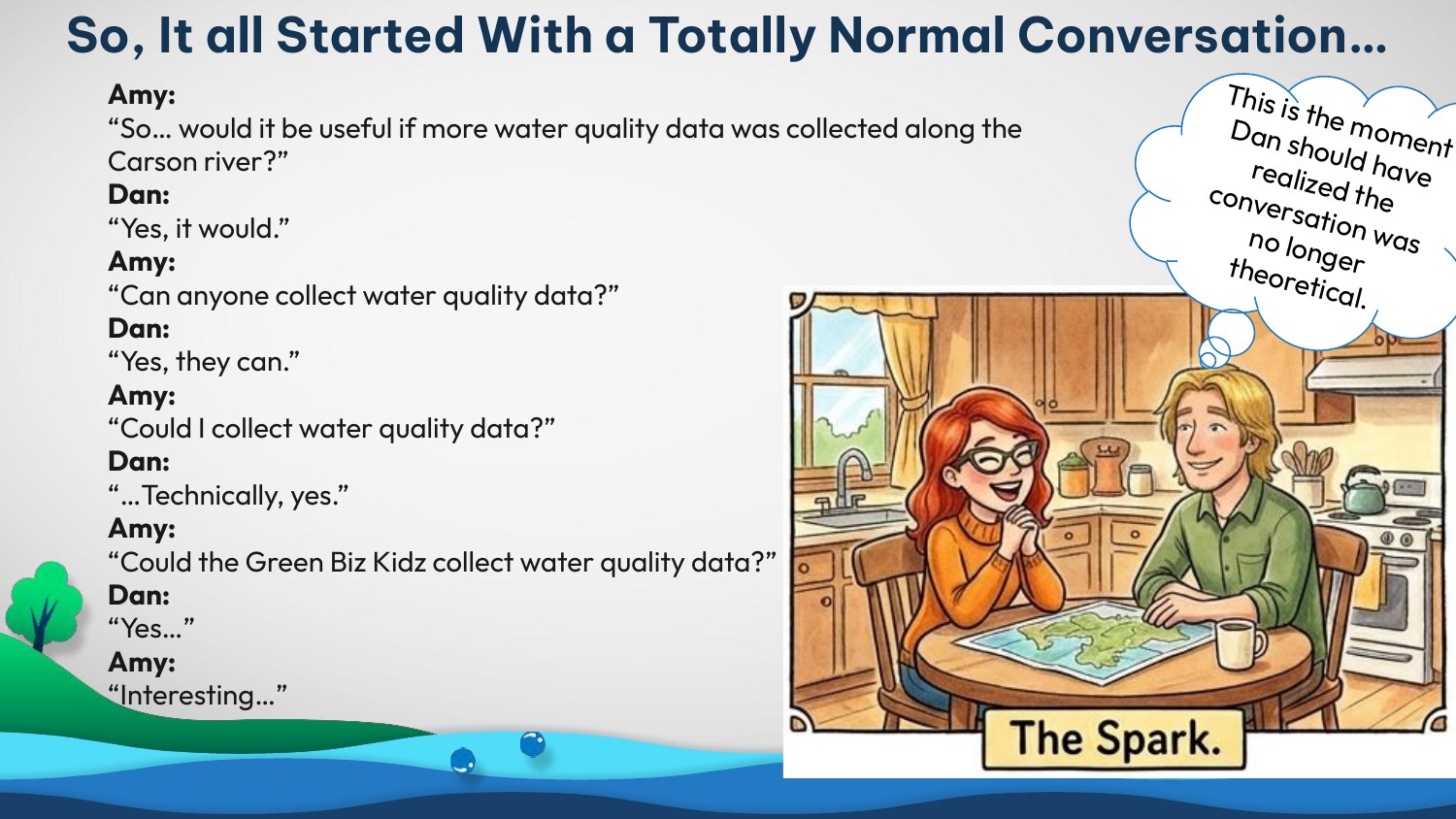
The conversation went like this.
Amy: “So… would it be useful if more water quality data was collected along the Carson River?”
Dan: “Yes, it would.”
Amy: “Can anyone collect water quality data?”
Dan: “Yes, they can.”
Amy: “Could I collect water quality data?”
Dan: “…Technically, yes.”
Amy: “Could the Green Biz Kidz collect water quality data?”
Dan: “Yes…”
Amy: “Interesting…”
That is the moment I should have understood that the conversation was no longer theoretical. I did not understand that. I thought we were chatting.
The tiny follow-up question
The next question was “so what would be needed to actually do this?” — and because I have spent almost twenty years around this work, I could answer it in detail, which turned out to be an act of self-sabotage.
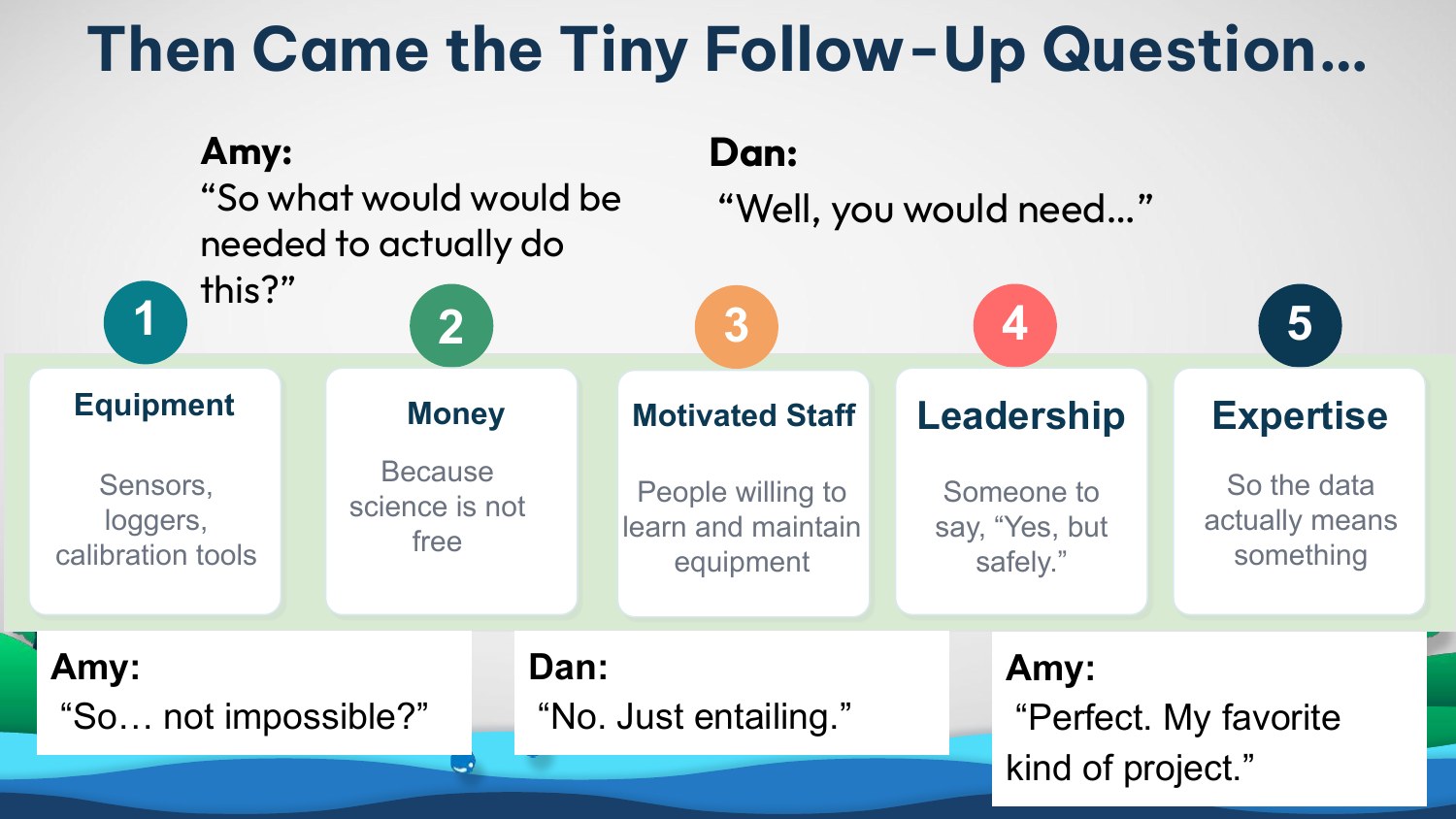
Five things. Equipment — sensors, loggers, calibration tools. Money, because science is not free. Motivated staff willing to learn and maintain the equipment. Leadership, meaning someone in a position to say “yes, but safely.” And expertise, so the data actually means something.
Amy: “So… not impossible?”
Dan: “No. Just entailing.”
Amy: “Perfect. My favorite kind of project.”
We priced out what a basic monitoring program would need. It came to about $5,000.
At roughly the same time, the Rotary Club of Carson City happened to have a grant opportunity available for — conveniently — $5,000.
Assembling the watershed Avengers
The Rotary grant emphasized community partnerships, which is how we ended up spending a month asking people who care about students, science, rivers, and stewardship whether they wanted in.
River Wranglers said yes immediately. What if students could help collect real water quality data from the Carson River? What if it connected watershed education across grade levels? What if students were not just learning about science, but actually doing it? Their answer was “absolutely, we would love to support a project like that” — at which point, as Amy put it, the idea had officially escaped her brain and entered reality.
The Nevada Division of Environmental Protection agreed to support the technical side — equipment setup, calibration, deployment, monitoring protocols, data quality, and connecting student work to real science careers. The project now had adult supervision, which is always reassuring.
Ms. Hoppe, our principal at Eagle Valley Middle School, got the version of the pitch that opened with “so… this might sound a little far-fetched.” She said “tell me more,” heard the whole thing, and gave it her blessing.
Carson City Parks, Recreation and Open Space we had already been working with on several other projects — which is presumably why Amy did not think to mention Project FLOW to them until about a week before we deployed equipment in the river they manage. That conversation was essentially “hi, so, we’re putting water quality equipment in the river next week, want to come?” Their answer was “of course we’ll go with you guys.”
Then the Rotary Club awarded the grant, and Project FLOW moved from “wouldn’t this be cool?” to “oh wow, we actually have to do this now.”
And then the data showed up
Collecting data is one problem. Understanding it is a completely different one, and it is the problem I did not adequately warn anyone about.
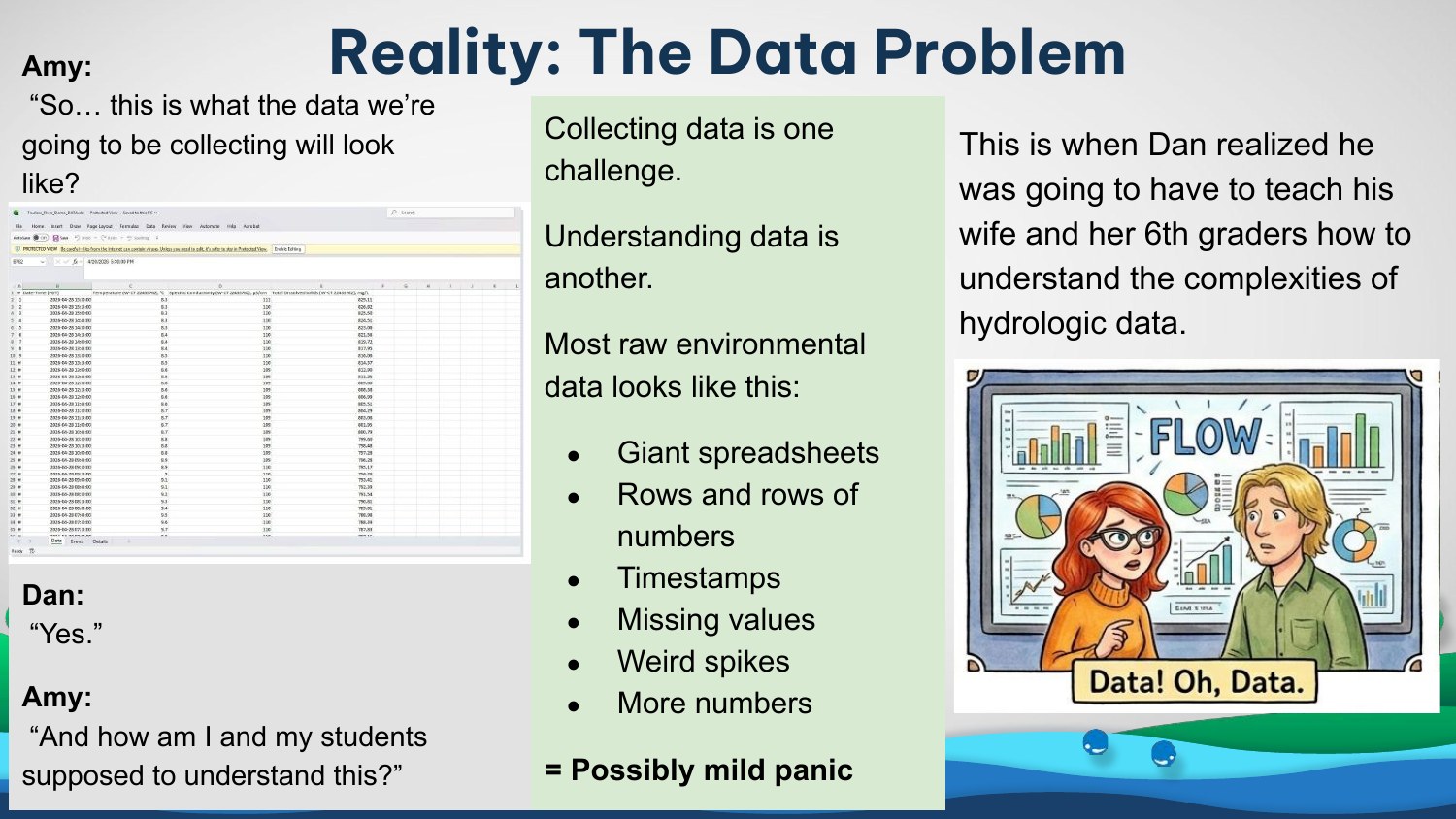
Raw environmental data is giant spreadsheets, endless rows of numbers, timestamps, missing values, weird spikes, and more numbers. Amy looked at a real sonde export and asked whether that was what they would be collecting. I said yes. She asked how she and her sixth graders were supposed to understand it.
A spreadsheet might technically contain the answer. It does not help anyone see what changed, when it changed, why it might have changed, whether that is normal, or what deserves attention. And the people who most need those answers — students, teachers, community members, nonprofits — are exactly the people handed the worst tools for getting them.
So I started building the thing that was missing. The agreement we landed on, and I am quoting the slide here, was that data should not require a decoder ring, three coffees, and a minor emotional breakdown.
That is the entire design brief for the Project FLOW platform. Everything since — the quality control that runs corrections before it runs checks, the flag-it-never-delete-it rule, the EduStream cards that surface a lesson when the data does something strange — is downstream of a middle school teacher asking why the numbers had to be so hostile.
I also became an honorary member of the Green Biz Kidz around this point, and was, as the slide puts it, involuntarily employed for life.
Launch day
April 30, 2026. Students, sensors, river access, community partners, and one teacher quietly thinking “please don’t let anybody fall in the river.”
Students were not pretending to be scientists that day. They were practicing real science — which, as the following months proved when the equipment was stolen and the whole program had to be rebuilt around hand-collected measurements, includes the part where things go wrong and you keep going anyway. That story is here.
The whole presentation
After the Rotary Club funded the equipment, we went back and told them the story — with cartoon versions of ourselves, because a slide deck about hydrologic data needs all the help it can get.
It covers the conversation, the partners, the platform, the launch, and where this could go from here: five counties in the Carson River watershed, and the observation that watersheds exist everywhere, Rotary clubs exist everywhere, students exist everywhere, and the need for environmental literacy exists everywhere.
The slides our students appear in are not in this version. The room it was presented to was a room; the internet is not, and photographs of middle schoolers are not ours to publish there. The same instinct is why the platform does not ask for student names.
Thank you
To the Rotary Club of Carson City, for funding the equipment and believing in the vision. To NDEP, for technical guidance, calibration support, and scientific expertise. To River Wranglers, for watershed education that puts students at the center. To Carson City Parks, Recreation and Open Space, for access and stewardship along the river. To Eagle Valley Middle School and Ms. Hoppe, for supporting a big idea that opened with “this might sound a little far-fetched.” And to the Green Biz Kidz, for being brave, curious, capable, and willing to do real science.
Also, to date, only one student has fallen in the river. We are calling that a success.
Project FLOW is now a chapter-based program — Eagle Valley Middle School is the founding chapter, and the model is built to travel to other schools and other watersheds.